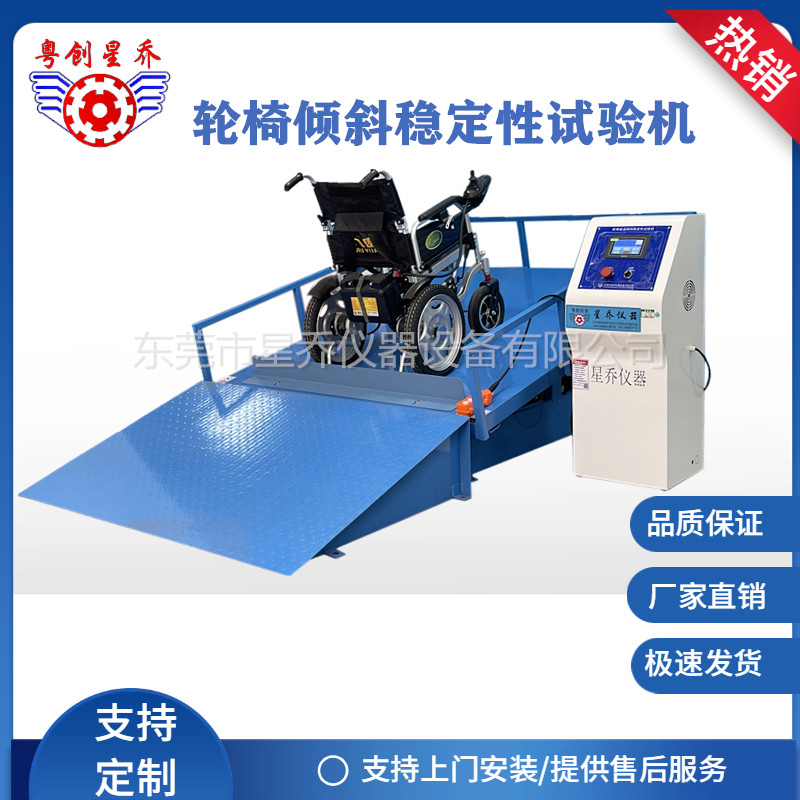
New standards for wheelchair detection equipment
ISO 7176-1:2014 "Wheelchair Vehicles - Part 1: Determination of Static Stability":
This is the basic standard for global wheelchair static stability testing. It specifies the test requirements for lateral static stability and rearward static stability, such as by slowly tilting the test platform or applying lateral force, recording the critical tilt angle at which the wheelchair begins to tip over, the lateral tilt angle of a manual wheelchair is usually required to be ≥ 15°; by applying vertical loads to the wheelchair backrest or rear part, or adjusting the backward tilt angle of the test platform, testing the critical load or angle for the wheelchair to rearflip, the rear flip angle of a manual wheelchair is ≥ 25°. In addition, detailed definitions have been made for the pre-treatment of test samples, test environment, load simulation, etc.
AS/NZS ISO 7176-1:2015 "Wheelchair Vehicles - Part 1: Determination of Static Stability":
This is a regional adaptation version of ISO 7176-1:2014 by Australia and New Zealand. The core technical requirements are consistent with the international standard. At the same time, for the common slope terrain in Australia and New Zealand, the test requirement of "Slope Static Parking Stability" has been added, and higher requirements have been set for the recording accuracy of test data.
ISO 7176-2:2017 "Wheelchairs - Part 2: Determination of Dynamic Stability of Electric Wheelchairs":
This standard systematically and comprehensively specifies the testing methods and index requirements for the dynamic stability of electric wheelchairs. It standardizes the test scenarios, including that the straight-line driving speed should cover the common speed range of electric wheelchairs (0.5 - 10 km/h), the steering test should set 3 typical turning radii (0.8m, 1.2m, 1.8m), and the slope test should set 4 slopes of 5°, 8°, 12°, and 15°. At the same time, it clearly defines the core quantitative indicators such as the critical angle of side roll, driving trajectory deviation, and the maximum climbing speed. For example, the side roll angle during straight-line driving should be ≤ 40°, during steering it should be ≤ 35°, on a 12° slope, the maximum stable driving speed of the electric wheelchair should be ≥ 2 km/h, and there should be no backward movement.
GB/T 18029:
This is a relevant standard in China concerning tricycles and four-wheel vehicles. The part related to wheelchair testing equipment stipulates the dynamic climbing performance of wheelchairs, etc. The relevant testing equipment must meet the requirements of this standard to ensure the safety of various types of wheelchairs in different environments.