
Baby stroller lifting and lowering test machine
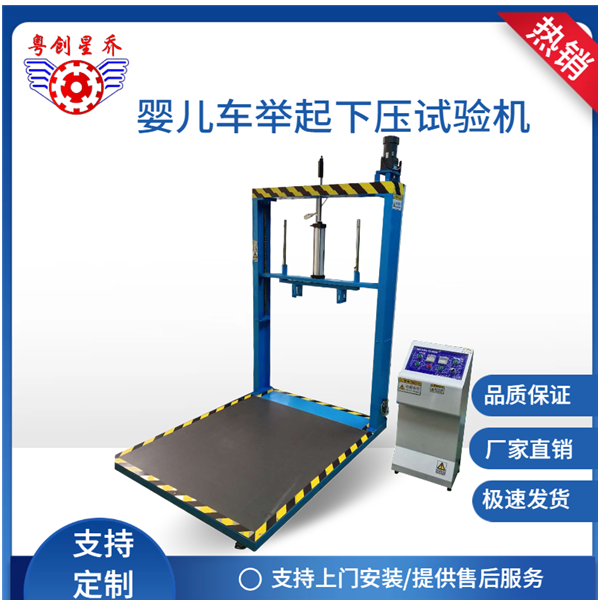
XQ-6263 baby stroller lifting and lowering test machine
I. Scope of application for the baby carriage lifting and pressing test machine:
The baby stroller lifting and pressing test machine is suitable for simulating the durability test of hand-cranked baby strollers when they lift and press over obstacles. It is manufactured according to the CNS test standard. The testing method is to place a model baby in the stroller frame, lift the stroller so that the rear wheels are 150mm away from the ground, and press down so that the front wheels are 150mm off the ground. The test is conducted at a speed of 15 ± 1 times per minute, and continuously repeated for 3000 times. After that, visually check if the stroller frame is damaged. When the set number of tests is reached and the operation can automatically stop, it can be operated for 24 hours without personnel supervision.
II. Test standards for the baby stroller lifting and lowering machine:
Designed and manufactured in accordance with AS/NZS2088:2000, ASTM-F833, CNS 6263-11, BSL-1996, EN1888:2003 and other standards.
III. Main parameters of the baby carriage lifting and pressing test machine:
1.Load capacity: 100 pounds
2. Test stroke: 120 - 150 mm (The stroke can be adjusted to any value within the US or European specifications by adjusting the screw)
3. Test speed: 15 times per minute ± 2 times
4. Driving method: Pneumatic driving type
5. Driving horsepower: AC 220V / 50HZ
6. Up and down adjustment range: 500mm
7. Machine dimensions: Approximately 2300 x 1400 x 1900 mm
8. Test power supply: AC 220V * 1.5KW
9. Body weight: Approximately 230KG
10. Effective height: MAX 1000mm
11. Test work: Single-seat vehicle body
12. Test Counting: The counting is displayed in six-digit liquid crystal digits and is set by the user.
IV. Operating instructions for the baby stroller lifting and pressing test machine:
1.Fix the baby carriage onto the fixture of the lifting and compression testing machine.
2. Operate the testing machine to make the vehicle platform perform lifting and lowering movements. Control the height of the rear wheels off the ground during the lifting and lowering process, which should be 200mm ± 10mm. Conduct a continuous test for 3000 times at a frequency of 15 ± 1 times per minute, with back-and-forth operations.
3. Check whether there is any visible damage to the structure of the stroller.
4. Speed Adjustment: When the panel is opened, two time relays can be seen. By adjusting these relays, you can change the speed at which the cylinder moves up and down (the default setting is 2 seconds, with a variation of ±1 second per minute).
V. Precautions for the Baby Carriage Lift-Down Testing Machine:
1.During the test, drainage should be carried out at any time to prevent damage to the cylinder's lifespan.
2. During the test, the test personnel should keep observing on-site to prevent the detached parts from getting stuck in the transmission components, which could cause damage to the testing machine. If any abnormal phenomenon occurs during the test, the machine should be stopped immediately for inspection.
3. When the machine is not in use, please turn off the main power supply.
4. The instrument should be kept clean. Especially on the test table, it must not be damaged by impact and must not be contaminated.
5. Please regularly add lubricating oil to the bearing housing to ensure the normal operation of the bearings.
6. The lifting and lowering screw rod should be kept clean and regularly lubricated to maintain its condition.
7. After each test is completed, please turn off all the switches and the power supply of the machine.